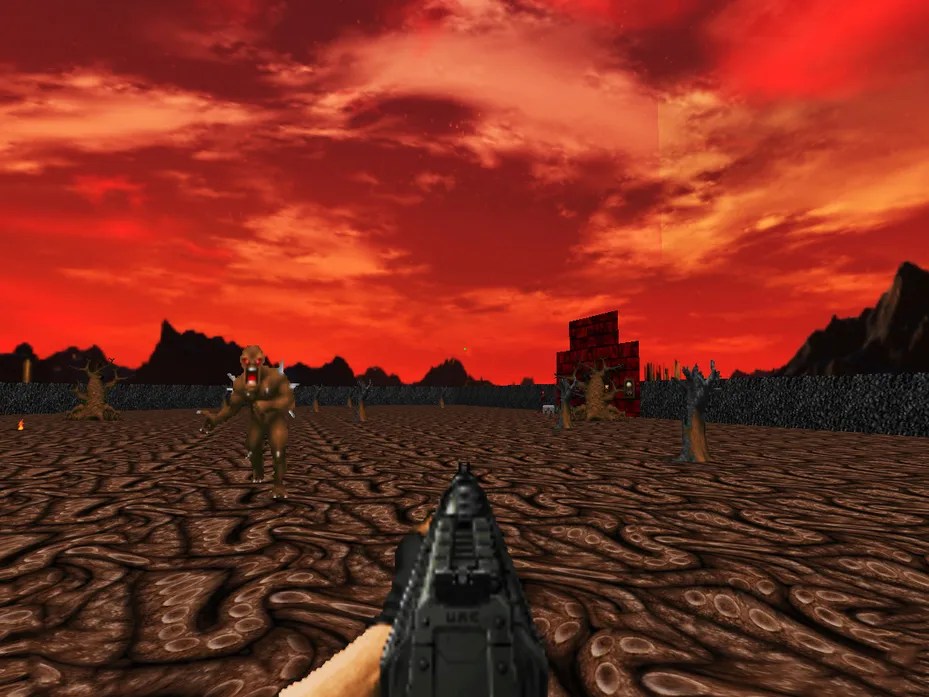
This is not meant as a satyrical piece. I just think that the backgrounds from Doom did an admirable job at illustrating the landscape of post apocalyptic Earth.
For starters, I looked at the wiki for “Motor Vehicles,” (https://en.wikipedia.org/wiki/Motor_vehicle#Comparison_by_regions). It indicates that there were 1,083,528,000 car registrations world wide. Of these registrations, about 16. million were electrical cars. (http://chrome-extension://efaidnbmnnnibpcajpcglclefindmkaj/https://iea.blob.core.windows.net/assets/e0d2081d-487d-4818-8c59-69b638969f9e/GlobalElectricVehicleOutlook2022.pdf). The wiki indicated that there were 406,770,000 truck and bus registrations, which also included minivans, SUVs, and light trucks.
Imagine a world in which the Fossil Fuel Empire has halted its propaganda and political campaigns to derail effective climate change legislation. Let’s assume also that the various shipping, trucking, automobile, and petrochemical, trade associations have likewise given up their efforts to prevent such policies. Let us further assume that the companies that can produce electric vehicles do so, and produce no more internal combustion vehicles. Let us still further assume that practical, electrical semi trailer vehicles can be made for reasonable prices (currently this is being worked upon).
If all of this happens (very difficult goals already), and we manage to replace 100,000 gas powered vehicles per day with electrical ones, it would take 40 years to replace all of them. Climate change isn’t some administrative problem that will be solved by altering policy in a few undetectable ways and then we go on again with life as we’ve practiced it for the last 100 years.
Inconvenient? of course it is inconvenient. How much of a hassle was it when livery owners had to sell their horses when it became clear the automobile would take over? How difficult was it when cobblers had to stop manufacturing shoes because factories were producing them so cheaply? How difficult was it when pumping gas was no longer a way for the uneducated to make a living?
Nor does this stylized example solve the problem of replacing petrochemicals in all of their destructive forms. Look at your room right now and remove everything in it that’s made from petroleum. For me, that means removing: 3 telephones, 3 tables, the upholstery to a loveseat, a couch, and a chair, 3 protective furniture coverings, a thermostat, 4 throw rugs, a dozen dog toys, 8 pillows, an artificial Christmas tree, the paint on 6 dining room chairs, a dining room table, plus, all of the lights, and several coats of paint. ETC.
True, a lot of what I mentioned above could be made out of different materials, but none of these products will be as inexpensive as the plastic/petrochemical versions. In short, we will have to learn how to deal with either having less “stuff” than we used to own or with the fact that it will all become noticeably more expensive.
This all makes Dr. Seuss’ The Lorax (1971) a surprisingly prescient book now. It told the story of a single factory owner who used every single Truffula Tree so that he could produce and sell Thneeds, which “everyone needs.” The argument for his overconsumption is the same as the basic one behind capitalism. If we don’t continue to economically grow, we will die. Somehow, investors will have to satisfy themselves with a sustainable version of “constant growth.” (Sigh). Lots of luck. The day that this country’s plutocrats willingly give up their claim on economic hegemony is the same day Sam Bankman-Fried admits he’s just a poorly-dressed, socially awkward thief.

From left, The Once-ler and The Lorax
 Bittersweet Abattoir